



Choosing the right worktable top. A guide.
In a modern worktable modularity and the ability to personalize individual table elements is a key point. Each element should be completely tailored to the function the workstation is intended to perform, starting with the work surface. As a result table top should be tailored to the type of tasks and work being performed.
In this article, we will introduce the different types of worktops available and their advantages and disadvantages, which will make the process of choosing the right type of workbench top for your business much easier.
Personalized workstations - a guarantee of effective process optimization
In an era when the concept of lean management is becoming increasingly influential in the operation of companies, a modern and quality workstation should guarantee the greatest possible optimization of production processes. The guarantee of achieving these goals is, among other things, to maximize the ergonomics of workbenches and to ensure that workstations are as modular as possible and can be personalized and adapted to specific functions and tasks.
The choice of precisely configured and modular workstations is a guarantee of effective optimization of production processes.
„The choice of precisely configured and modular workstations is a guarantee of effective optimization of production processes.”
The two basic components of any work table are its structure (frame) and the work surface. In this article, we will primarily address the issue of choosing the right tabletop.
What kind of tabletop will be best? It depends...
The first important point to consider is the type of material from which such a tabletop should be manufactured. What kind of tabletop will be the best? It depends, because there is no single right answer to such a question. The choice of the optimal type of worktop depends primarily on:
- the industry in which the company operates
- the type of work to be performed on the particular post
- the rate at which this work is to be performed
- tools and materials that will be used in performing the job
- the area in which the workstation will be installed
| Type of work being performed | Suggested tabletop |
| Light assembly work, less intense packaging processes | 18 mm or 25 mm laminated chipboard |
| More intense assembly work |
30 mm laminated chipboard, 30 mm varnished plywood |
| Intense packaging processes | 30 mm laminated chipboard covered with 1-2 mm thick galvanized or stainless steel sheet |
| Heavy workshop labor (high risk of damaging the top) | Plywood covered with 1-4 mm thick galvanized or stainless steel sheet depending on needed protection level, optional reinforcement of the tabletop edge |
| High risk of component damage / Need for better protection and shock absorption with heavy labor | Varnished plywood or laminated chipboard top covered with grooved rubber |
| "Wet" work - risk of water, oil, coolant contact | Covering the top with galvanized steel, stainless steel or rubber |
Different tasks require different solutions - companies involved in automotive and heavy industry tend to look for more robust solutions for heavier work with heavier loads. Light assembly work can be done on workbenches with lighter tops. Intensively used packing stations in distribution centers need dedicated solutions to avoid rapid wear and tear, and electronics manufacturing in EPA zones requires specialized worktops to protect against electrostatic discharge. In the food industry, on the other hand, it is essential that workstation countertops meet strict health and safety standards. As you can see, the industry has a significant bearing on the choice of a particular type of tabletop for a workbench. But there are no rigid rules here either. In addition to a broader look at the industry, you need to look at the task for the specific workstation you are planning - the type of work (heavy or light), its intensity and frequency (for example, how many times a day, on average, heavy parts will be moved across the worktop), as well as the specific tools and parts that will be used when working on that particular worktop. It is also important to remember to take a holistic view of the space in which the work tables will be placed - whether there are any traffic paths nearby, whether the countertop will be at risk of being hit by a cart, etc. Only after considering all these factors can you begin to choose the right type of tabletop.
Among the available models of worktops, we can distinguish their several basic types.
Top made of laminated chipboard
A basic solution for most workbenches that works well for a wide range of assembly and production work, as well as less intensive packaging and parcel shipping processes. Depending on the dimensions, it is usually made of 18 mm, 25 mm or 30 mm thick board. The edges of the laminated chipboard after cutting are wrapped with ABS, optimally 2 mm thick. Work tops made of this material are a versatile and cost-effective solution. They are relatively resistant to cracks and scratches, and are easy to keep clean..
The standard color of laminated chipboard tops is light gray RAL7035..
ESD tabletop
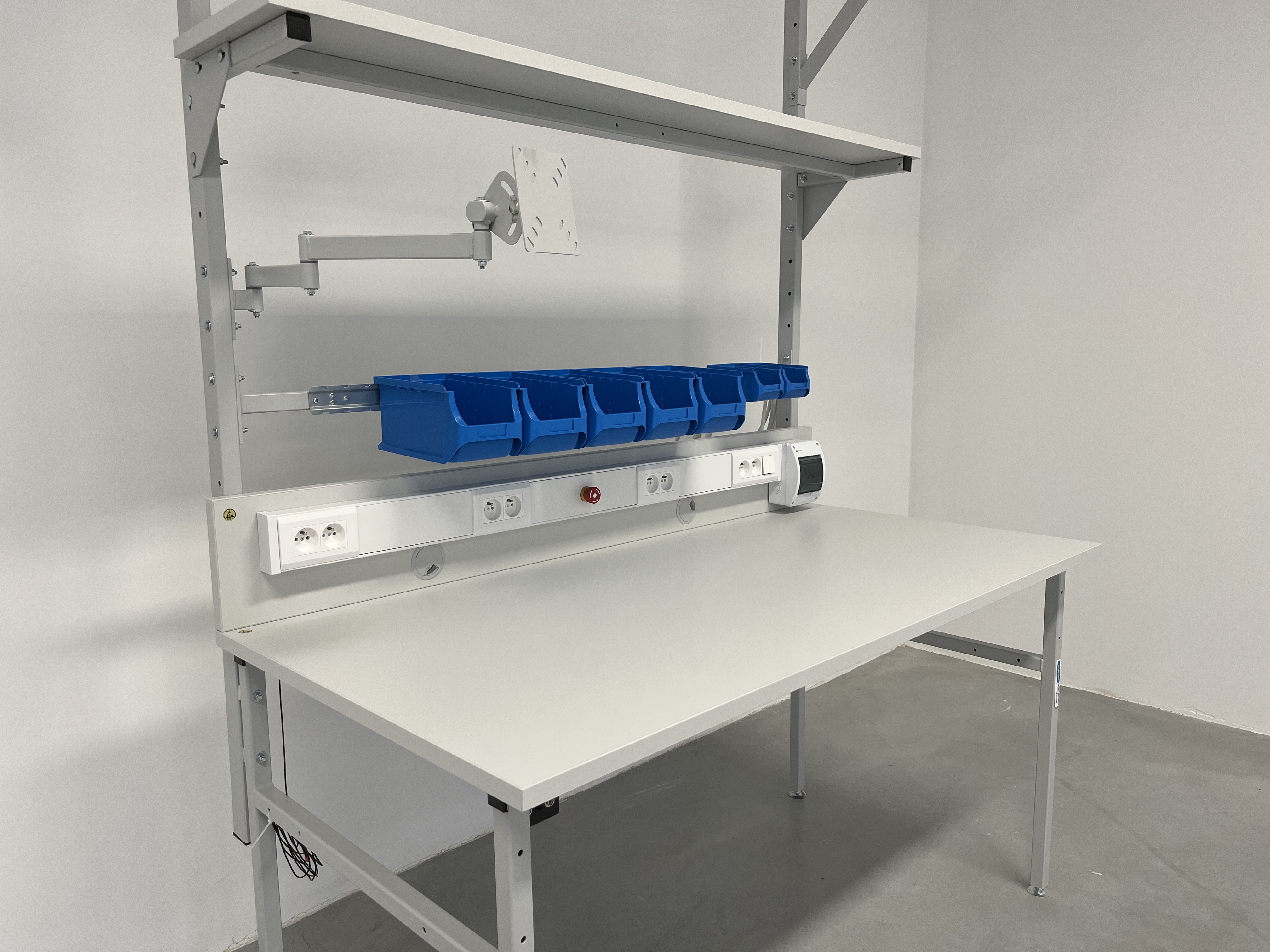
ESD worktops will find application especially in the electronics industry, where ensuring an adequate level of antistatic protection is extremely important. ESD worktops are a more convenient solution than specialized ESD mats installed on standard worktops - if a table is equipped with an ESD worktop, the use of a mat is no longer necessary. As a rule, they come in a standard thickness of 25 mm and are covered with ESD laminate (standard color is light gray RAL7035), so that electrostatic charges will be dissipated from the surface of the tabletop.
Top made of varnished plywood
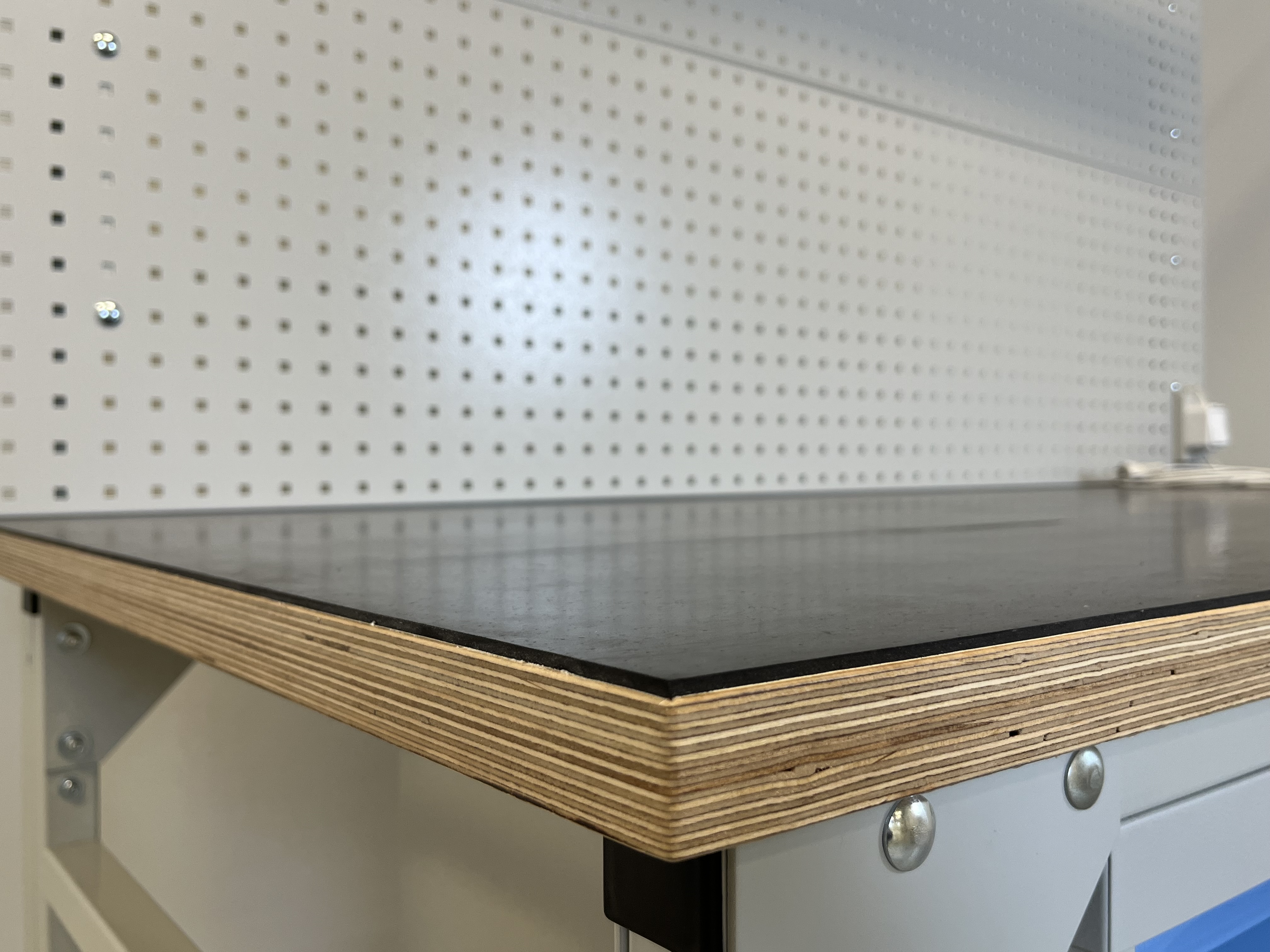
A plywood top is usually used in workbenches designed for heavier work, which require greater resistance to damage. These types of tabletops also withstand heavier loads better. Plywood worktops are also usually thicker than laminated board worktops, and are typically available in 30-40 mm versions. Note that a plywood top does not "like” moisture, so if exposed to liquids it is better to equip it with an additional covering (rubber, stainless steel or galvanized steel sheet).
Top with sheet metal or rubber covering
Both laminated board and plywood worktops, depending on your needs, can be additionally covered with sheet metal, or rubber. As for sheet metal covers, here, too, different variants are available:
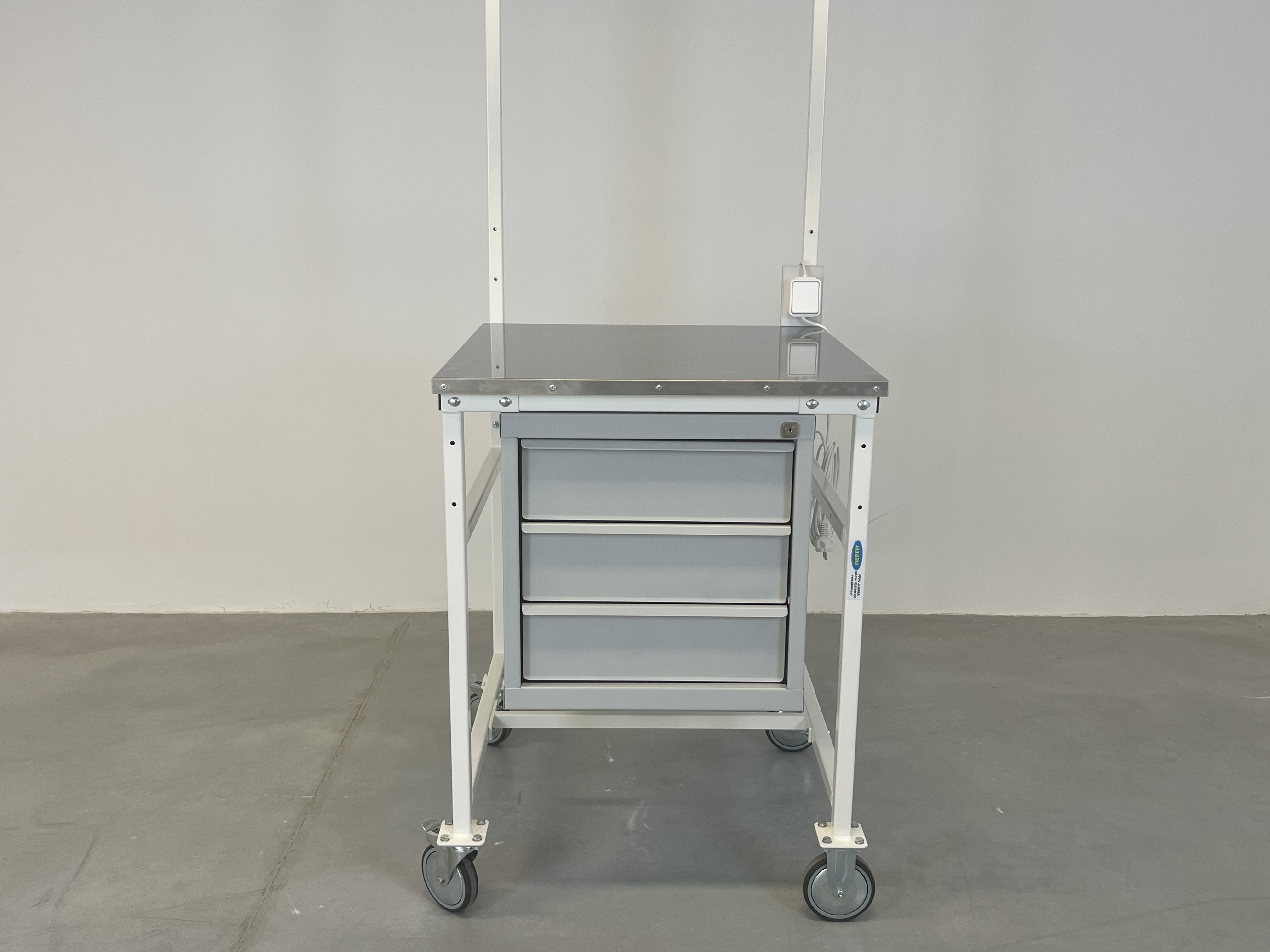
- Galvanized steel sheet 1-2 mm thick. The table covered with galvanized steel sheet is more resistant to damage and abrasion. In addition, it is more resistant to water and other liquids, such as various chemicals (it is also easier to clean). Therefore, it will perform well in heavy work, as well as when exposed to liquid contact.
- Stainless steel sheet - available depending on requirements in a variety of options from 1 to even 4 mm. Like galvanized steel sheet, it is more resistant to liquids, including some chemicals, and is more resistant to scratching and abrasion, so the countertop is slower to deteriorate. In addition to heavier work, it will also work well as a cover for parcel packing tables, where cardboard boxes are often moved and knives are used to cut packing materials (such as foil).
„By covering the board or plywood top with additional sheet metal or rubber padding, you get increased resistance to damage and liquids.”
The worktops can also be covered with rubber (usually the top surface, without edges), either smooth or grooved. Rubber increases the table's resistance to impacts and scratches, by cushioning the blows. Rubber can also have, for example, oil-resistant properties, which is an added advantage when there may be stains from grease and coolant on the table.
Other specialized worktop designs
For workstations used in the food industry, worktops must meet stringent standards and must be made entirely of stainless steel or synthetic material. Quality control workstations often require specialized backlit desktops, which few manufacturers offer.
Size does matter
In addition to the material, the work surface must also be properly sized for both the type of work being done and the user. All tools and parts must fit on the table and be properly organized. The worker should have easy access to all tools - they should be within easy reach. That is why work tables are usually offered in a dozen standard sizes. A great advantage is also the possibility of ordering personalized workstations with unusual dimensions.
Tabletop shape and additional cutouts, tilting and folding tops
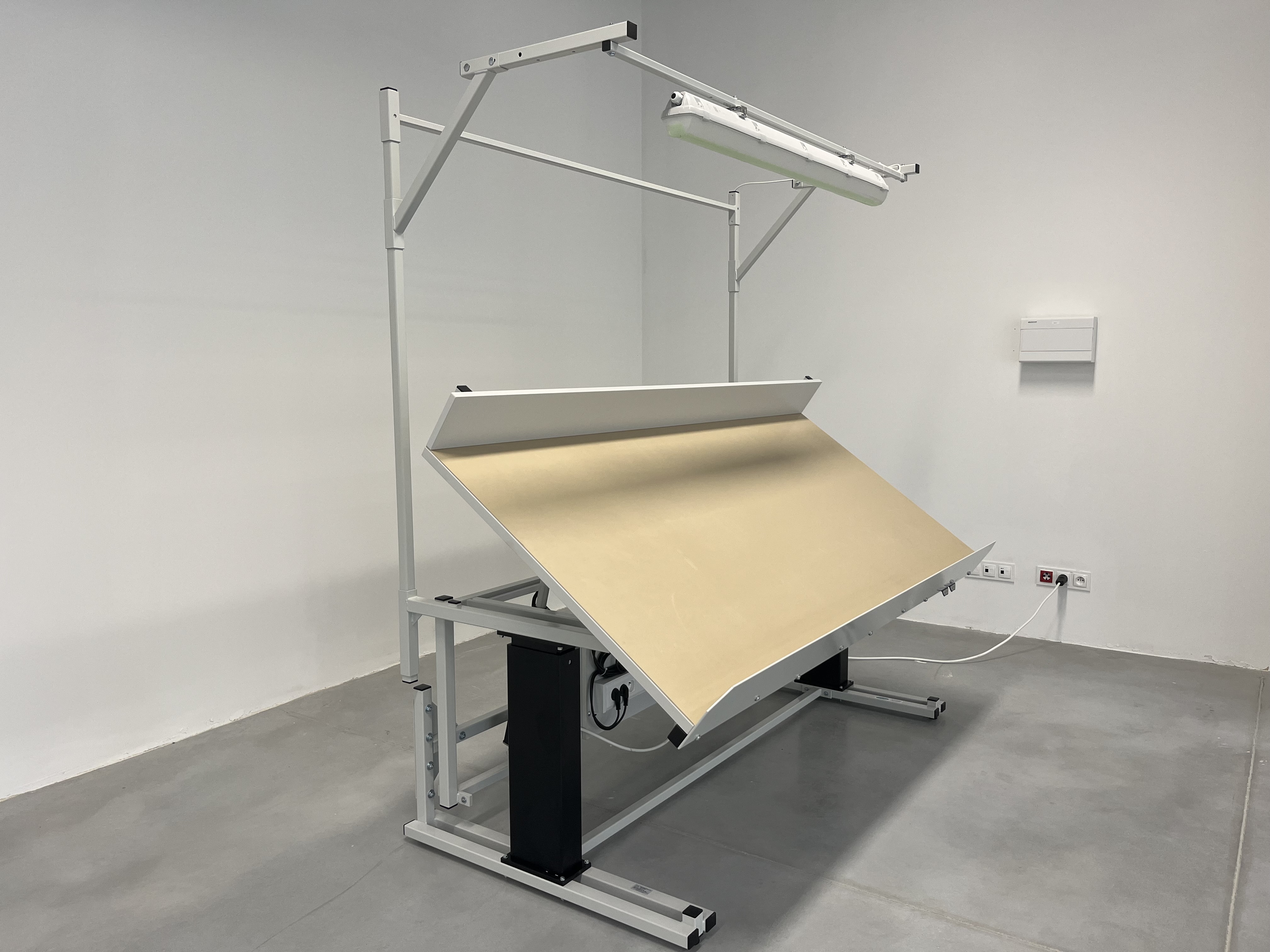
Most work tables are equipped with typical rectangular tops, regardless of the type of material used. In some cases, the tops must be equipped with appropriately made cutouts for additional equipment, or to fit into the production line. The specific nature of the assembly of some products, such as automation, also makes it necessary to equip the table with a tilting top. If there is little space in the plant, folding tops will work well. Care should be taken when choosing a supplier to make sure they are capable of making such personalized workstations.
Summary
As we pointed out at the beginning of the article, choosing the right worktop is not at all that obvious and depends on many different factors. When configuring the right workstation, it is worth seeking the support of specialists who will be able to ask precise questions and advise accordingly on such a choice. It is also worth taking care to choose a supplier who is able to guarantee the greatest possible personalization of workstations and a wide range of offers - this way it is much easier to find “tailor-made” workstations. We encourage you to familiarize yourself with JABAMA's range of workstations: www.jabama.eu.
