



Practical tips to increase packing station efficiency
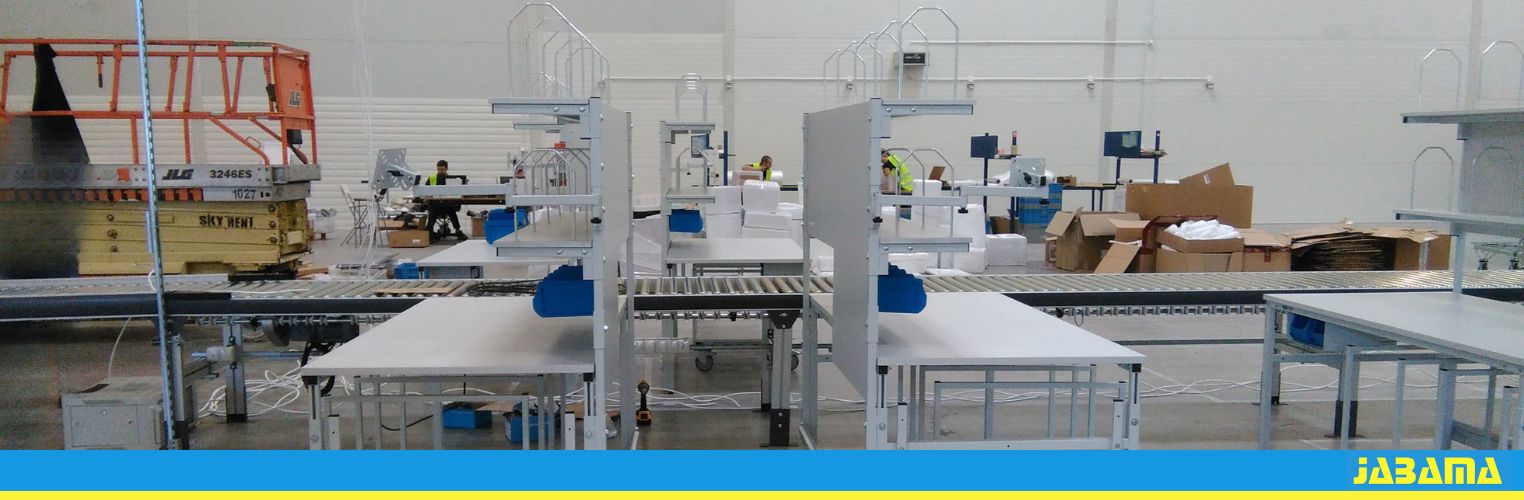
In repetitive processes, even small changes can generate significant time and cost savings. Packing is no different, as it is a key element of logistics operations in the e-commerce sector. As a reputable manufacturer of packing workstations, we have held many valuable conversations with people responsible for fulfilment in global logistics companies, who shared their insights with us during the workstation design process. These can be summed up very briefly: every movement matters. In this article, we outline which improvements are worth implementing in packing tables and in the organisation of packing-related work, based on our expertise and the experiences of our customers.
Customization of packing tables beyond standard solutions
When logistics operators design or modernise shipping warehouses, they increasingly opt for highly customised packing workstations, tailoring them precisely to the process. When identifying requirements, they take into account the type and dimensions of items to be packed and prepared for dispatch, as well as the types of packing materials used, such as void fillers, paper, cartons or envelopes. It is also essential to determine which tasks will be carried out at the workstation from start to finish. What stages does the packing process consist of, will the parcels be labelled, and will quality control or parcel weighing also be performed at the station? It is also worth establishing how the shipment will be transferred onto the conveyor. Based on this information, specific needs regarding the design and equipment of the tables are defined.
Dedicated holders vs. universal shelves in ergonomic packing tables
From our customers’ feedback, we see that lean concepts are increasingly shaping how modern packing stations are designed. Process owners pay close attention to keeping the workstation tidy, eliminating unnecessary movements and standardising the way orders are packed. Every structural element of the table, as well as every item placed on it, must have a clear purpose and a clearly defined location.
For this reason, standard shelves – where all kinds of random, unnecessary items tend to accumulate very quickly – are often replaced with various types of dedicated holders mounted to the upper supports of the table or to a perforated back panel. Among the most popular holders are, for example:
-
label dispensers that make it easy and fast to apply labels to parcels
-
tape dispensers and brackets for handheld tape dispensers
-
containers for tape rolls
-
holders for bottles and cups
-
scanner holders
-
document holders
If a shelf is needed, it is also designed so that it fits only a specific item or device, typically a printer, PC or keyboard. When every necessary item has its own place, it becomes much easier for operators to build “muscle memory” and reach for the right tools without thinking, the workstation stays organised, and essential items are less likely to get lost.
It is worth noting that implementing this concept is more expensive and requires careful analysis of which elements are truly needed so that there are no gaps in the lean packing system. At the same time, the growing popularity of “holderisation” does not mean that shelves are inherently worse. Shelves are definitely more versatile, provide more storage surface and can still be kept well organised – they just require a bit more discipline and self‑control from the people using them.
Creating space for packing materials
Every item needs to be packed into something – most often into cardboard boxes, envelopes or poly mailers. The packaging then has to be filled and the product properly protected using various types of void fill, such as paper, film or foam inserts. A packing table should make it easy to store these materials and packaging in an orderly way, often across multiple size variants.
The simplest and very common solution is to use dividers mounted on a shelf, under the worktop or next to it. These dividers make it possible to organise and group folded cartons, envelopes or poly mailers into clearly separated sections. Depending on the requirements, they can differ in height and load capacity – for example, we manufacture them from aluminium wire or from welded thin-walled profiles. Importantly, it is also possible to add adjustable spacing for the dividers on the shelf.
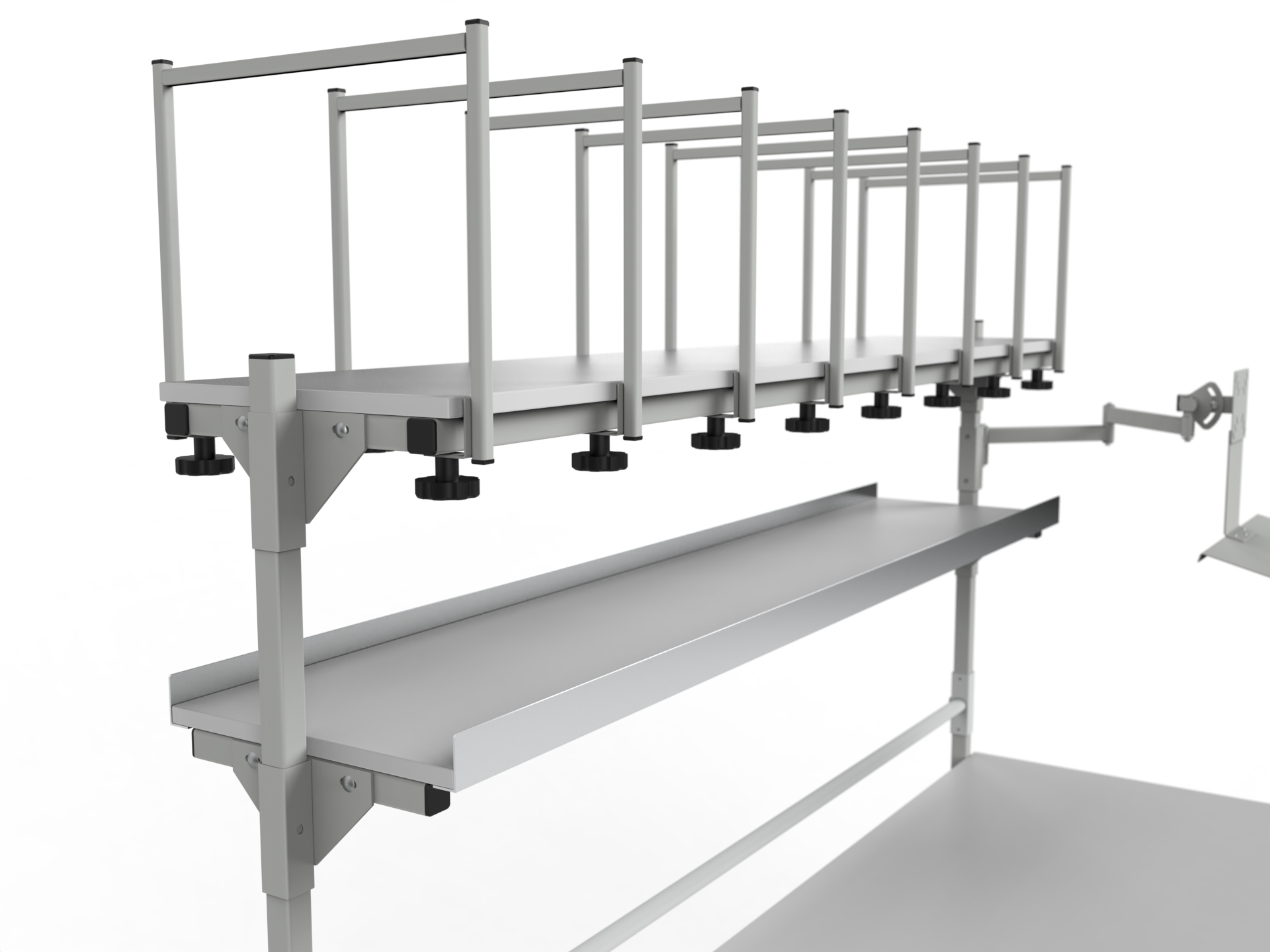
Another interesting solution is to use dispensers for packing paper or large bins in the form of baskets filled with loose void-fill materials or corrugated cardboard. Packing materials supplied on rolls, such as packing paper or bubble wrap, are mounted on dedicated rollers and bars, and a cutter is often added to make it easy to cut the material directly from the roll.
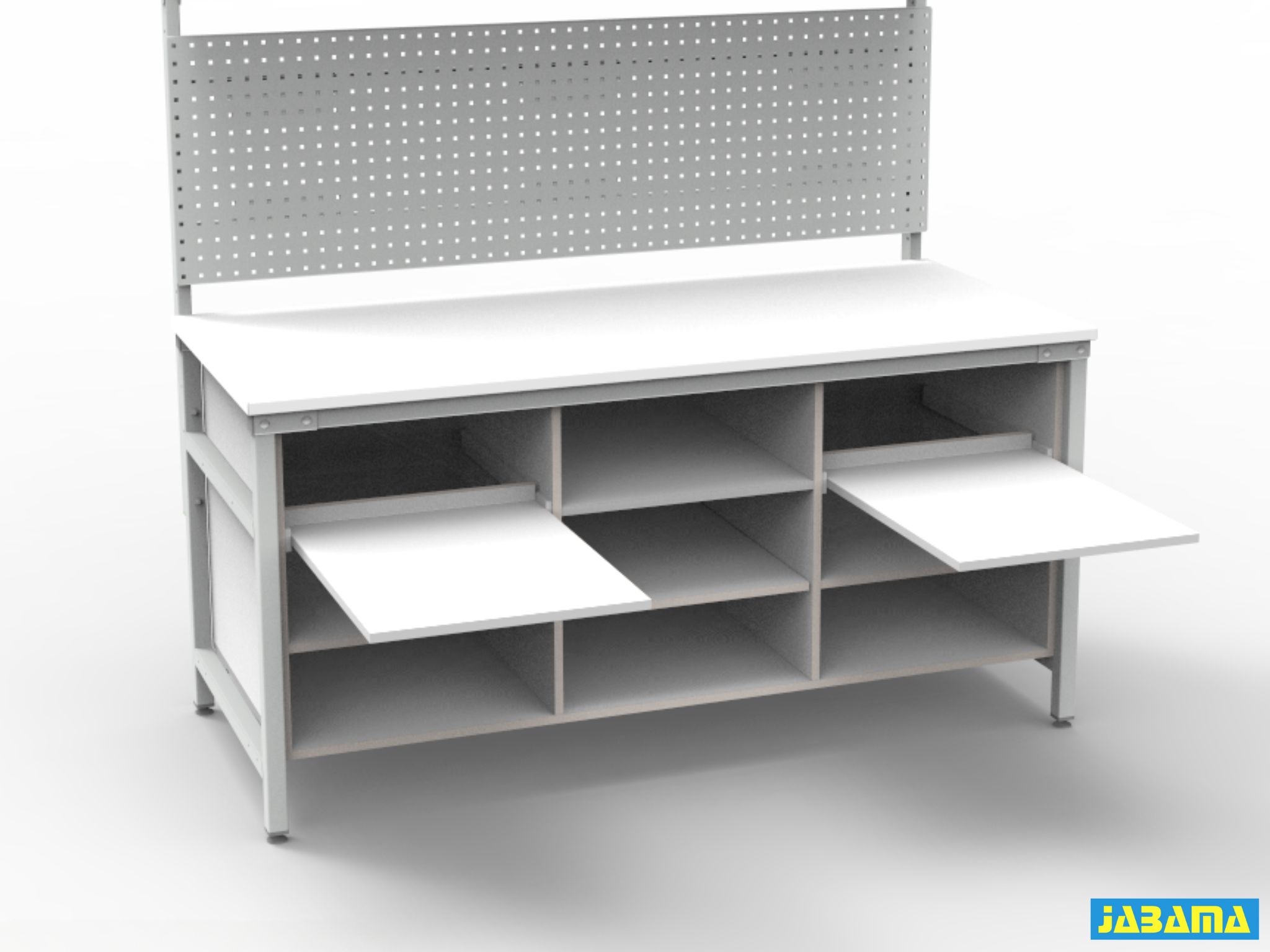
Another concept is to create a larger number of built-in (often pull-out) shelves in the space below the worktop. Each shelf is used to store specific types of cartons, envelopes or other materials. In some cases, this makes it possible to completely dispense with the upper add-on of the table and instead rely on low, more massive bases for the packing and order fulfilment stations.
Introducing a clear labelling system for each element
Simply adding multiple dedicated holders or storage sections for packaging and void-fill materials is not enough. All elements and sections of the table should be clearly labelled so that operators never have to wonder where a given accessory or material is supposed to be stored. The easiest way to implement such a system is to use simple stickers or labels indicating individual compartments or holders.
By introducing clear visual labelling, you can increase efficiency and speed up the packing process, as operators no longer waste time thinking about where things are. At the same time, a good labelling system helps minimise errors, for example picking the wrong material, format or type of packaging.
Adapting warehouse tables for electronic equipment
A modern, ergonomic packing workstation should make it easy to integrate all the electronic devices needed in the process. If a desktop PC and monitor are required at the packing station, the table should include a dedicated shelf for the computer and a suitable monitor arm so that the screen does not take up valuable work surface. You also need to plan where to place the mouse and keyboard (if the screen is not touch-enabled), and often a scanner, label printer, standard printer and various machines that automate parts of the packing process. It is essential to position all of this equipment in such a way that it does not reduce the usable working area needed for packing and for freely turning parcels on the table, which usually means designing dedicated shelves and brackets.
As part of organising the workstation, it is also worth thinking about cable management – using covers, cable trays and grommets to tame the usual tangle of leads. This not only improves safety and ergonomics, but also makes the station easier to clean and maintain.
Height adjustment is becoming essential – boost efficiency by improving ergonomics
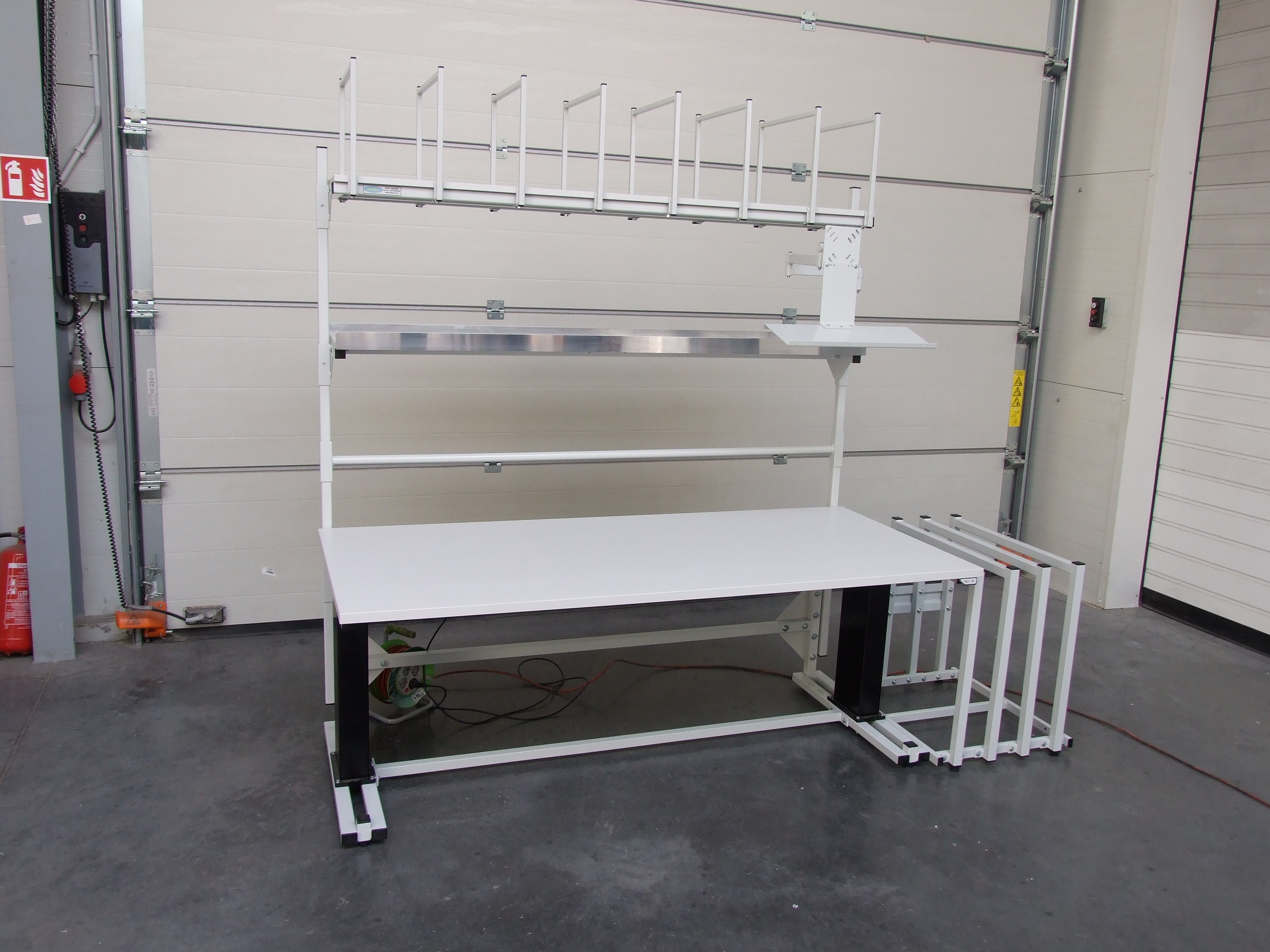
We have noticed a growing number of enquiries about height-adjustable packing stations, especially those with electric adjustment. This is an extremely ergonomic, user-friendly solution that works very well in shift-based operations where several people of different heights and reach share the same table. When heavy items need to be lifted onto the table and then rotated during packing, the option to temporarily lower the worktop is a huge advantage.
Our electric packing tables offer a height adjustment range between 680 and 1070 mm. Thanks to the use of in-house manufactured electric lifting columns, these workstations can achieve the same high load capacity as standard versions (300 kg) and high structural strength, which means they can also be equipped with upper add-ons and accessories. Importantly, our accessories are compatible with the frames of height-adjustable stations. In cases where this is not possible, we have designed dedicated accessories specifically for electric tables.
When talking about adjustment, it is also important to mention the ability to fine-tune the position and height of all accessories, such as shelves, lighting, holders, monitor arms and more. The supports to which these elements are mounted should include some form of adjustment system. This can be a pattern of mounting holes drilled at defined intervals, or gantry-style profiles that act as rails on which accessories can be freely repositioned. As a result, each element can be placed at an optimal height, within comfortable reach of the operator, who can quickly and easily grab everything they need.
Another useful feature that customers often mention is the ability to adjust the dividers for cartons mounted on shelves or under the worktop. This makes it possible to adapt carton storage sections to the current mix of sizes and order profiles. This is one of the options offered by our modular Jabama packing tables.
Packing tables must be robust and reliable
In e‑commerce there is no room for errors caused by poor build quality of the workbenches used for packing parcels. Decision-makers who recommend warehouse equipment up the chain want to be sure they are choosing the highest possible quality solutions. Before giving a positive recommendation, they therefore verify the manufacturer and carefully check the build and load capacity of the tables on offer. Logistics processes are, by nature, very intensive, and the equipment must not fall apart after just a few months of use. At Jabama, we are fully aware of this and put strong emphasis on designing stable, durable workstations that will perform reliably for many years.
Possibility to optimise workstations after purchase
No matter how thorough the analysis carried out before purchasing packing stations, reality will always bring surprises. This is why logistics managers in fulfilment centres want to be sure that the tables they have already bought can be modified later if needed, to reflect process improvements that only became apparent over time, for example through repeated feedback from warehouse staff. It is therefore worth making sure that the current supplier offers a high level of after‑sales support and is able to make the necessary workstation modifications on request. In many cases these are simple issues, such as adding an upper add‑on section or installing specific accessories. As a manufacturer, we have dealt with such cases many times and have always done everything we can to implement customers’ ideas and leave a truly professional impression.
Summary
Packing tables are a critical element of every shipping warehouse. By introducing many small but meaningful improvements, it is possible to significantly increase the efficiency of work at the packing station. Personalisation plays a key role, as it allows you to adapt the table to specific warehouse processes. Clothing, furniture and electronics are all packed and prepared for shipment in very different ways, and each product category requires a different approach to workstation design.
Keeping the workstation tidy, eliminating unnecessary movements and making smart use of the available space are becoming increasingly important. This helps you shorten packing times and reduce the risk of errors. High load capacity and durability remain equally valuable, as they are the foundation of trouble‑free, low‑maintenance operation. That is why it is so important to rely on solutions from reputable manufacturers who can design high‑quality, well‑matched packing stations for your warehouse.
