



Tips for Choosing a Workshop Cabinet
First, we need to dispel any doubts – there is no single, universal cabinet that will work in all conditions. Its usefulness is influenced by too many factors: workspace dimensions, type of work performed, on-site conditions, frequency of use, room layout, or the type and quantity of tools to be stored. For this reason, we won't find a model that works always and everywhere, although some solutions have broader applications than others. Therefore, it's worth considering our expectations first, comparing them with available products, and only then making a purchase. In this article, we'll address the most important issues – those affecting user comfort, ergonomics, and safety.
Size and Capacity
These are the first, basic parameters we should consider when selecting the appropriate workshop furniture. Of course, it would be a mistake to simply search for the largest available model and purchase it without thinking – such a cabinet could obstruct access to machines, force the need to walk around it when moving through the room, or create a hazard when opening. We would thus achieve the opposite of the intended effect and make our work more difficult instead of streamlining it. The selection process can be reduced to three simple points:
- Measure the space in your workshop where you plan to place this furniture, taking into account the location of windows, doors, and existing equipment - to ensure it will fit without the need for ad-hoc adjustments. The size of your workshop has a significant impact on the ability to customize the cabinet to your individual needs.
- Collect and assess the dimensions of your tool collection (also considering its future expansion) and other materials and parts used in your workspace. For example, consider how many types of screws or bolts you'll need, take inventory, and determine how many items you'll store in the workshop.
- Choose a cabinet with appropriate dimensions, capacity, and load capacity to accommodate equipment and seamlessly fit into the work space – also consider how it opens.
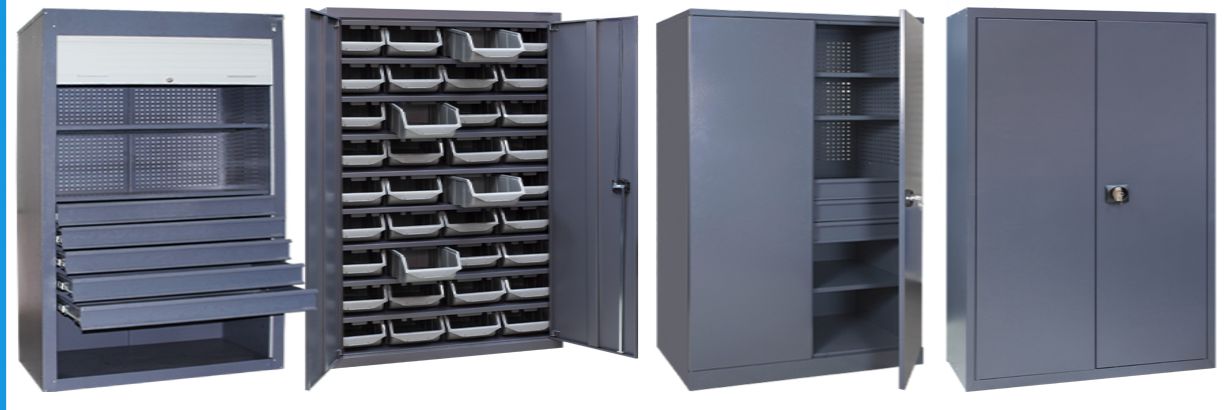
A particular point of interest here may be the type of closure; in some situations, using ordinary doors may not be advisable – for example, when they could block passageways, communication routes, or access to machines we need. Then a roller shutter can help, which although somewhat slower to use, doesn't require allocating additional space for opening doors.
These few simple activities won't take much time but will save you worries related to using furniture poorly suited to your workshop.
Materials and Durability
Workplaces can differ in environment – dust, humidity, temperatures, or the presence of chemicals such as all kinds of solvents, paints, lubricants, and oils. The environment can vary significantly; for example, a workshop in a metalworking shop will be much more contaminated than an appliance repair service. When selecting equipment, it's worth paying attention to the material the cabinet is made of, and the safest and most cost-effective material for a cabinet that will have to constantly remain in often harsh conditions is steel, specifically steel sheet metal, additionally protected by well-executed powder coating. Metal furniture protected in this way is easier to protect against corrosion, abrasion, and chips that could otherwise lead to rapid surface degradation.
As important as the material itself is the construction – thicker sheet metal will significantly affect resistance to mechanical damage and structural stability, door reinforcements or a durable roller shutter will make accidental – or intentional – breaking difficult, and additionally reinforced connections will guarantee the longevity of the whole.
Other, less popular but still used materials include aluminum and laminated board, which will also work in specific situations.
Interior Layout – Tool Cabinet Functionality
Storing items is the basic and most important function of a workshop cabinet - therefore, it's important to choose equipment that best fits our needs, through the prism of which a stable and functional product is evaluated. Most models available on the market consist of various configurations of drawers and shelves, so a bigger problem than finding a specific configuration will be determining which variant will be ideal in a specific situation. Here it's worth going back to earlier points, specifically the assessment of the size of the tool set used. If we'll be storing large quantities of small parts and other items – we can lean toward a greater number of drawers and/or special perforations of housing walls or doors, enabling the hanging of additional storage containers. When large elements are more important to us – we can be tempted by a layout consisting entirely of shelves and perforated walls, which will enable mounting of tool holders, paper towels, and other important items available in every workspace. Perforated walls are an interesting solution because they guarantee the possibility of extensive personalization. There are many holders and hooks, and you can mount sets of wrenches, screwdrivers, and smaller power tools such as drills in them.
In the case of drawers, it's also worth paying attention to two aspects – unit load capacity dependent on construction and materials, and slides – higher quality and ball bearings will positively affect the longevity of both their contents (for example, due to load capacity) and the cabinet housing, and full extension (telescopic models work best here) will facilitate access to contents. Drawers can be equipped with various types of dividers, organizers, foam inserts, and other dedicated accessories (such as inserts for CNC machine heads), thanks to which you don't waste time searching for tools.
Safety in Workshop and Garage
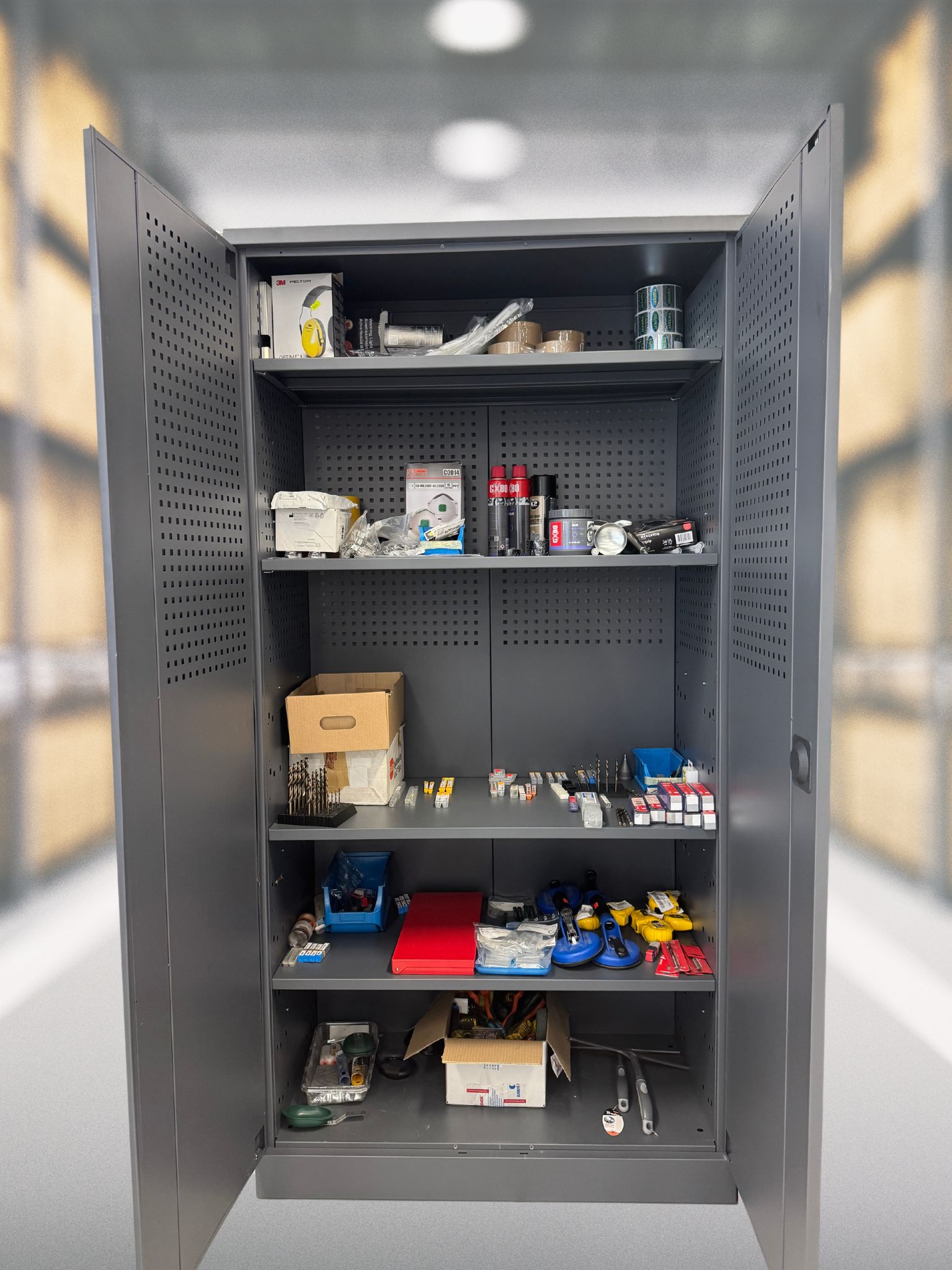
It may happen that an unauthorized person will try to gain access to tools stored inside the cabinet. This sounds serious, but it could be a curious child checking the contents of our garage or a coworker wanting to "borrow" equipment they don't normally have access to. In both these situations and many other scenarios, tragedy can occur, so it's worth protecting against them using a very simple yet effective solution – a central lock. A solidly constructed model will solve the problem of unauthorized access almost completely – combined with a durable construction, doors should be impossible to break without specialized tools.
Another, perhaps less obvious advantage of a lock is protection against injuries and accidents – locked drawers won't slide out on their own, doors won't open exposing someone to injury. This will also protect the cabinet's contents from falling out.
Additional Equipment for Workshop Furniture
We've already discussed the most important parameters related to cabinet selection – when we've already chosen a model with appropriate dimensions, construction, and layout, we can consider selecting more specialized elements that may be useful in more specific situations and facilitate maintaining order and organization in a service or garage. These include, for example:
- Perforated panels – mentioned earlier, they are a permanent fixture in workshops and garages due to their versatility. They enable mounting of numerous accessories – containers, holders, power strips, and many others. This is a simple and popular solution that can significantly increase the usefulness and actual capacity of a cabinet. Additionally, holes improve air circulation. In good quality tool cabinets, for example, rear walls or inner sides of doors are perforated.
- Storage containers – made of lightweight plastics and mounted on perforated panels or special racks/slides. Available in both single removable and multiple integrated versions, they help with sorting and accessing small elements – e.g., screws, nuts, or washers.
- Dividers – allow you to easily turn a drawer into a practical set of containers and facilitate maintaining order. They are characterized by diversity and therefore easy customization.
- Foam inserts – ideal when planning to store large quantities of small tools and bits in a drawer. Foam keeps all elements in place and prevents their free movement during closing and opening.
- Magnetic holders – will allow storage of tools where there's no perforation. Due to the steel construction of the entire cabinet, they can be used everywhere – taking into account ergonomic and safety principles.
- Labels – some cabinets have them as equipment, they can also be purchased separately in magnetic or adhesive versions. They can significantly improve cabinet functionality and workshop organization. Thanks to markings, you reduce time spent searching for tools, and users gain easy access to needed components.
ESD – Professional Antistatic Protection
In some industries, especially in electronics (e.g., SMT circuit assembly), protection against electrostatic discharge (ESD) is critically important. In such situations, it's necessary to use equipment variants made of conductive materials or coated with such substances - in the case of workshop cabinets, due to steel construction, this involves ensuring proper grounding and painting with ESD-conductive paints. It's also worth noting that storage containers or foams used in such furniture should also be in ESD versions. A cabinet selected and equipped this way will enable storage of materials and products sensitive to discharge, without fear of damaging them.
Other Workshop Furniture – Workshop Table and Tool Trolley
An important element in the workspace, alongside the tool cabinet, is the [workshop table](https://jabama.pl/stoly-warsztatowe). Due to work performed on it and its surroundings, it should be made of solid, durable materials – a thick top made of laminated board or plywood (sometimes covered with sheet metal or lined with rubber) and based on a reinforced construction of steel profiles (also thicker than in typical work tables, for example 40x40 mm), which will withstand greater weights and resist potential damage. Additionally, using additional equipment such as perforated panels and tool containers will further streamline access to tools, which after completed work can be safely stored in the cabinet. The load capacity of a workshop table should be around 400-500 kg as standard.
It's also worth considering purchasing a [workshop trolley](https://jabama.pl/wozki-transportowe-wozki-narzedziowe), which will ensure mobility and access to needed tools even away from the station where we usually store items we need daily. However, they must also meet certain standards - trolleys should be made of materials as durable and damage-resistant as cabinets, this also applies to wheels, on which the entire structure ultimately rests. Therefore, their diameters, treads, and brakes should be appropriately selected.
Optimization – Pay Attention to Space Organization
Improving ergonomics and work efficiency related to using a cabinet doesn't end with its assembly and filling according to a predetermined plan. Using the accessories listed in the previous part of the article, as well as the processes we'll discuss, you can maximize the effectiveness of your workshop furniture and consequently – your work. In a factory, especially at large scale, every time saving means additional savings through increased efficiency, which can translate into gaining a slight advantage over the competition.
Functionality Guaranteed by Smart Storage Solutions
The previously discussed additions such as holders mounted on perforated panels or magnets can cheaply and effectively increase our cabinet's capacity, while facilitating access to contents held on them. This has particular significance in cases of limited space, where we can't increase storage capacity by simply adding another piece of furniture – in such a situation, thoughtful management of cabinet interior can exponentially increase its effectiveness and enable personalization consistent with changing needs. An example might be using dividers in drawers when we need more space for small assembly elements instead of tools – then free, undivided space becomes a problem increasing clutter. Plastic insertable containers and boxes can remedy this, turning a drawer into an organizer with a set of containers.
Similarly, holders in certain situations can significantly increase vertical storage capacity (otherwise this space could be wasted), especially if we're dealing with tools of irregular or elongated shapes. A big advantage here is also freedom in arrangement according to personal preferences.
Modularity and Adaptation to Changing Conditions
Work rarely stands still, and neither do its requirements. In a garage, we may sometimes deal with car repairs and other times with fixing a broken washing machine. In a production facility, production line reconstruction may be needed. Situations change, and with them – needs. Hence it's worth being aware of the numerous options that open up with the purchase of a high-quality workshop cabinet.
Many models have shelves that can be pulled out and either completely removed (remember to properly store the unused shelf to prevent its damage or loss) or change its position to adapt the interior to new needs, e.g., larger tools.
It's also worth remembering to place items we use frequently in an easily accessible (and preferably well-marked) location so as not to waste valuable time searching for them. Items used occasionally can be placed, for example, in the lower part of the cabinet, so we won't have to constantly bend down. This is not only practical but also ergonomic and protects user health.
Summary. A Tool Cabinet Is an Essential Element of Your Workspace
A workshop cabinet is an indispensable element of every serious workspace such as a workshop, garage, service, or metalworking shop. Properly selected furniture will help shorten the time needed to access tools, increase material safety, and improve organization, promoting the establishment and maintenance of order. These advantages remain irreplaceable regardless of whether we need the cabinet in a garage for DIY work or for professional applications in industrial workshops. Therefore, treat the time spent selecting the right model as reconnaissance before making a smart investment that will save you time in the future, additionally increasing comfort and ergonomics. If you're looking for high-quality workshop furniture, in the JABAMA online store you can comprehensively equip any workspace, and the solutions we offer can be modified to create solutions 100% tailored to individual needs.
