



Comparison of workshop tables: which one to choose?
The workshop table is the heart of any workshop, workroom, or service shop. It is the central place of work, where the most important production and service tasks related to the manual work of workshop workers, assemblers or service technicians are carried out. Therefore, the choice of the right workshop table can significantly affect important factors from the company's point of view, such as work efficiency, employee safety, or the quality of manufactured products. In this article, we will present a comparison of such workbenches, highlighting the advantages and disadvantages of different types of workshop tables. We will also hint at what important issues such as the range of accessories to pay attention to when making such a choice.
„It is the central place of work, where the most important production and service tasks related to the manual work of workshop workers, assemblers or service technicians are carried out.”
How do workshop tables differ from traditional worktables?
Let's take a fundamental question, that is, how do workshop tables differ from other types of workstations? Workshop tables are a very broad and diverse category of products among the stations and working stands available on the market. Just type the phrase “workshop tables” into an Internet search engine to get a huge number of diverse results. But what is the difference between an assembly table and a workshop table? In order to get an answer to this main question, you need to ask yourself a few supporting questions. First, where will a workshop table work best? As the name suggests, workshop tables are designed for workshops (or garages, ironwork shops, service shops, craft studios and other manufacturing spaces) where manual work of a heavier nature (as opposed to light assembly or office work) is performed. Should the table design be different due to “heavier” tasks? These types of tables should be more durable, made of a different type of material, and should be equipped with a different type of accessories. What accessories should a good workshop table have? On this type of workstation for effective work, it is crucial to maintain proper order. Only properly configured workshop tables will positively affect such issues as the organization of work in the workshop.
Examples of workshop table types
We can divide workshop tables into different subcategories that perform different functions:
- Tables for carpentry shops: designed for woodworking in carpentry workrooms. Since wood is a softer material than steel, these types of tables are often based on a wooden structure with a hardwood plywood top They are often equipped with mounting holes for specialized tools used in woodworking.
- Service tables: for professional use in the servicing of various types of equipment, including car repair shops and bicycle repair shops, usually equipped with various accessories for storing a large number of tools like perforated walls with handles, tool cabinets, a frequent requirement for such tables is their mobility.
- Workshop tables for industry: are the equipment of various types of enterprises engaged in production, they are characterized by high durability, the greatest ergonomics and the need to meet the conditions for the installation of specialized machinery and tools. These types of tables must be adapted to intensive daily work and must be resistant to the conditions of professional workshops and ironworks.
- Garage workbenches: a popular type of workshop tables often purchased by individuals outfitting garages, basements, or amateur workshops. It is important that these types of tables are as versatile as possible. They are not as heavily used as industrial tables, and at the same time individuals often look for the cheapest possible solutions, so very often vendors offer more economical versions with slightly lower parameters. More demanding users should look for workshop tables of a higher class (e.g. for industrial or service applications). Workbenches for private use are sought by avid do-it-yourselfers, modelers, small-time craftsmen, whose hobbies involve doing various manual tasks.
The above classification is just one suggestion for grouping such workstations. You can just as well divide workshop tables by the material from which they are made (wooden tables, metal tables, tables made of mixed materials), or by mobility (fixed workstations and mobile tables). A separate and more specialized issue, on the other hand, are, for example, welding tables or ironwork tables. An analysis of the various categories of such workstations will make it easier to compare workshop tables.
Workshop ecosystem - how to design the workshop space well?
A well-chosen workshop table does not automatically mean an increase in productivity, because the workstation must be well integrated into the workshop itself (as an organizational unit and the room itself). Workbenches should be well sized for the area of the room. The table should also stand in a suitable place so that it does not interfere with the traffic routes established in the workshop and does not impede work at other workstations. If the place is dark, the table should be equipped with central lighting to facilitate work. Finally, it is very important that the table be well integrated with the rest of the workshop equipment: tool cabinets, workshop carts, storage racks and others. Access to each storage area for parts and tools should be easy and unobstructed, in accordance with ergonomic principles. The more equipment there is within reach, the better and healthier for the worker. If seated work will be done at the workshop table, care should be taken to select appropriate workshop chairs. For standing work, consider purchasing anti-fatigue mats (including ESD mats) to improve standing comfort. If you are looking for the the right equipment, for your workshop, we encourage you to take a look at the range of workshop furniture available in our online store.
„Finally, it is very important that the table be well integrated with the rest of the workshop equipment: tool cabinets, workshop carts, storage racks and others. Access to each storage area for parts and tools should be easy and unobstructed, in accordance with ergonomic principles.”
What to pay attention to when choosing the right workshop table? Basic inquiries before buying.
Before the final decision to purchase a workshop table, it is worthwhile to make a brief analysis of your needs:
- Will the workbench be utilized for amateur use, e.g. by a handyman in a garage or basement, or is it intended for professional use, e.g. in the ironwork room of an industrial plant?
- What will be the nature of the work performed on the table (somewhat lighter manual work with simple tools, or work with heavy or power tools)?
- What kind of processing will be done at the workshop table - woodworking, metalworking or other material work?
- What will be the size and weight of the parts, components and tools used?
- Will other tools such as grinders, vices, drills be mounted on the table?
- Will lubricants, solvents, varnishes and other chemicals be used as part of the work at the table?
Answering the example questions listed above allows you to choose the right workshop table for your planned needs. For example, workstations for professional use, where the work performed will be more regular and intensive should be more durable than a table for tinkering in the home garage. The same rule applies to the selection of the workstation for the corresponding nature of the work, the workpieces to be processed and the tools to be used: manual work with heavy parts using heavy tools and equipment installed on the table requires a workbench of larger size, durable and more stable than light assembly work. If chemicals are used as part of the work, the table top should be properly protected.
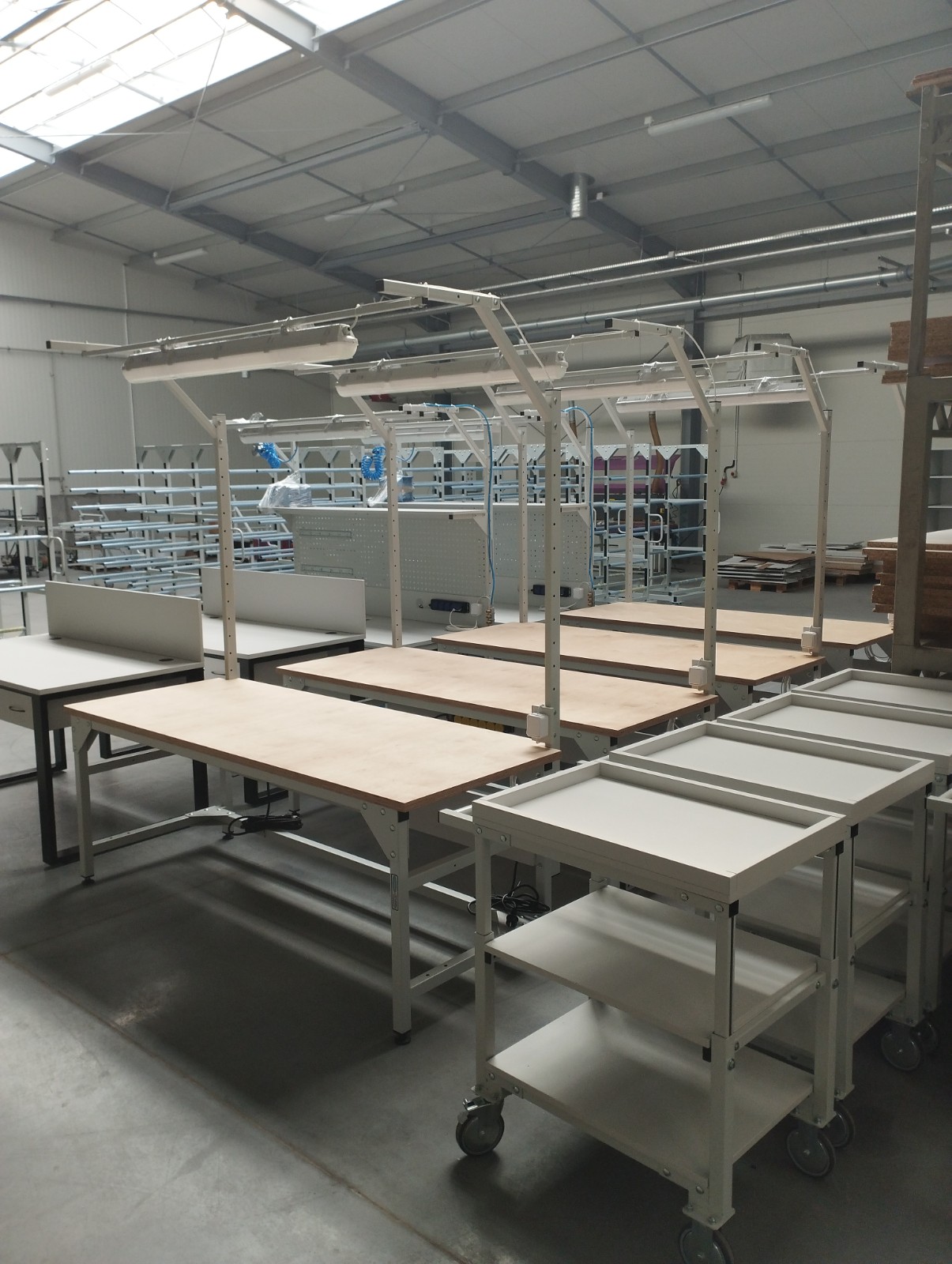
Basic parameters of workshop tables
The selection of a table will be made easier by evaluating the typical product parameters that most stores and manufacturers list on their websites. Thanks to these parameters, we can assess whether a given workshop table will be suitable by its dimensions, robustness, range of available accessories, or level of ergonomics.
„Metal tables are much more resistant to mechanical damage and have a higher weight capacity than alternatives.”
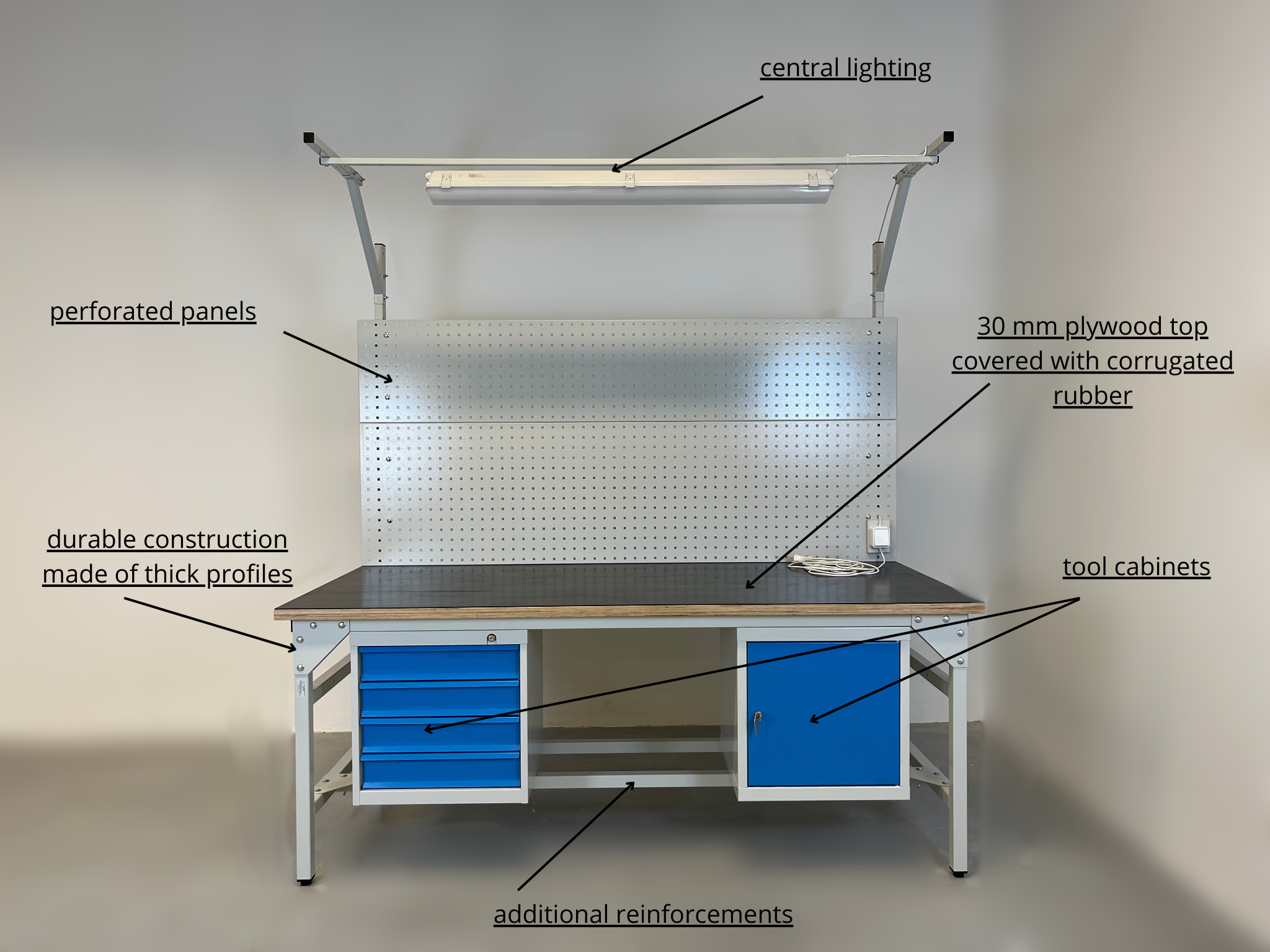
Type of construction: the vast majority of workstations are based on metal construction of various types of steel profiles, or sheet metal. Metal tables are much more resistant to mechanical damage and have a higher load capacity than alternative solutions (such as simple tables made of wood, or plastic). Jabama workshop tables use thicker profiles than typical workbenches, as well as additional structural reinforcements, which translates into greater load tolerance and lower failure rates.
Tabletop type: not only the structure of the workshop table should be significantly strengthened, but also the work surface itself. It should be thicker (30 mm or more) and made of materials with greater resistance to mechanical damage (impact, abrasion, scratching) and chemical damage (working with chemicals penetrating the tabletop, which can cause additional damage). Practical solutions include a top made of varnished hardwood plywood, which can be upholstered with steel sheet or lined with rubber for further increased resistance (see our article on choosing the right worktop, available HERE).
Dimensions: larger tabletop surface means a larger working area, which is usually important for workshop tables, where you often work with large parts and a large number of tools. Also important is the properly selected height of the work surface and the height of the rear top frame on which accessories are mounted. The dimensions and height of the table should be selected in such a way as to provide the maximum level of ergonomics for the user, which will guarantee the comfort of work and ultimately increase efficiency.
Additional equipment: very often, high-quality workshop tables are distinguished from cheaper substitutes by their modular nature and the wide range of accessories that can be installed. Among the extras typical of such workbenches, we distinguish under-counter tool cabinets with drawers, perforated panels with holders for tools (wrenches, screwdrivers, drills, etc.) and storage containers (e.g., for storing screws, nuts, bolts), central lighting, additional shelves to facilitate the organization of the workstation, or power strips for connecting electrical tools.
Optimal size and height of the workstation in the workshop
In a nutshell, according to the principles of ergonomics of workstations, the table should be tailored as much as possible to the user and to the type of work he performs. Will the work performed at the table be standing or sitting? Before buying, you should also consider how many table users there will be and how many types of work will be performed at the table. Then, based on the answers to these questions, it is necessary to select the appropriate size of workshop table tops. Therefore, it is important to be able to choose different variants of tabletop sizes and adjustable height if necessary (read our article on workstation ergonomics HERE). Another advantage of buying sucj tables directly from the manufacturer is that the product can also be made to size with non-standard dimensions. Here are two tips to keep in mind when choosing the right workstation:
- Typically, workshop tables should be equipped with a larger tabletop than universal worktables due to the larger size of the components used and the many different tools: a tabletop with a larger surface area will make it easier to order and better organize the workstation. At the same time, the tabletop should not be too large for the user.
- If the work performed at the table involves lifting and transferring heavy items to the table, the table must not be too high so as not to endanger the health of the table user.
Jabama workshop tables are available in various sizes. The base are two standard size variants: 1500x900x800 mm or 2000x900x800 mm (length x width x height), which are the result of years of experience and analysis of user needs. Workshop table designs in any size and configuration on request are also available, so you will always receive a properly dimensioned and therefore fully ergonomic workbench from us.
| Model | Length | Width | Height | Thickness |
| SMW0915 | 1500 | 900 | 800 | 30 |
| SMW0920 | 2000 | 900 | 800 | 30 |
| SMW custom | any | any | any | any |
Workshop tables on wheels: added mobility
Very often the organization of work in a given workshop, garage, or ironwork shop for various reasons (for example small space, the need to work near the object to be repaired) requires equipment in the form of mobile tables. In such workstations, the structure should be appropriately modified, and the set of wheels should be appropriately selected for the planned permissible loads. With mobile tables, the workstation can be easily moved from place to place.
Benefits of a well-suited workshop and garage table
A well-chosen table for a workshop is a guarantee of high productivity and user comfort and satisfaction. The design of the appropriate workstation should be very durable - metal workbenches are the best, and the top should be thick enough, properly protected and should guarantee a sufficiently large working surface to facilitate the organization of the work process. With practical additions, work will become much easier: cabinets and perforated panels make it easier to store tools and keep things in order, and lighting facilitates precise work, especially in less lit areas. If you follow these practical tips mentioned in this article, you will properly choose the best workshop table for you, which will withstand long and intensive use.
Benefits of a well-chosen workshop table:
- robust and stable, can withstand intensive manual work with heavy tools and other means found in the working environment
- maximum productivity and comfort from working at an ergonomic and well-configured workstation
- easier to keep your workstation organized and tidy with the right size and storage accessories
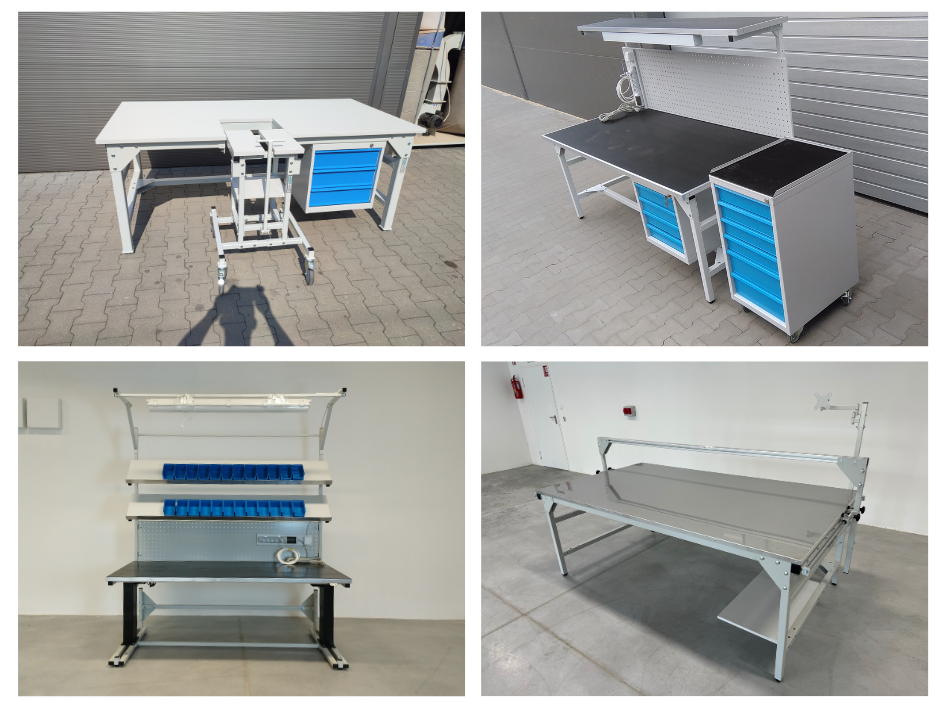
Custom made workshop tables
In some situations, workshop tables available on the market do not meet strongly personalized, non-standard criteria - for example, when it is necessary to make tables with highly non-standard dimensions, with an unusual type of adjustment (e.g. .electrically adjustable workbenches) or heavy workshop tables with ESD antistatic protection. In such a situation, it is best to use the offer of a workshop table manufacturer such as Jabama. Our team of specialists will analyze your needs, and our experienced designers will prepare a suitable, tailor-made project. We make custom workshop tables with unusual designs. If you are looking for such a product, we will certainly be able to help.
